
Can I claim a refund on faulty or defective goods?
Yes, if you have a faulty product claim, you can demand a refund. You have 30 days from the date of purchase or delivery, whichever is later. We can help you get a refund.
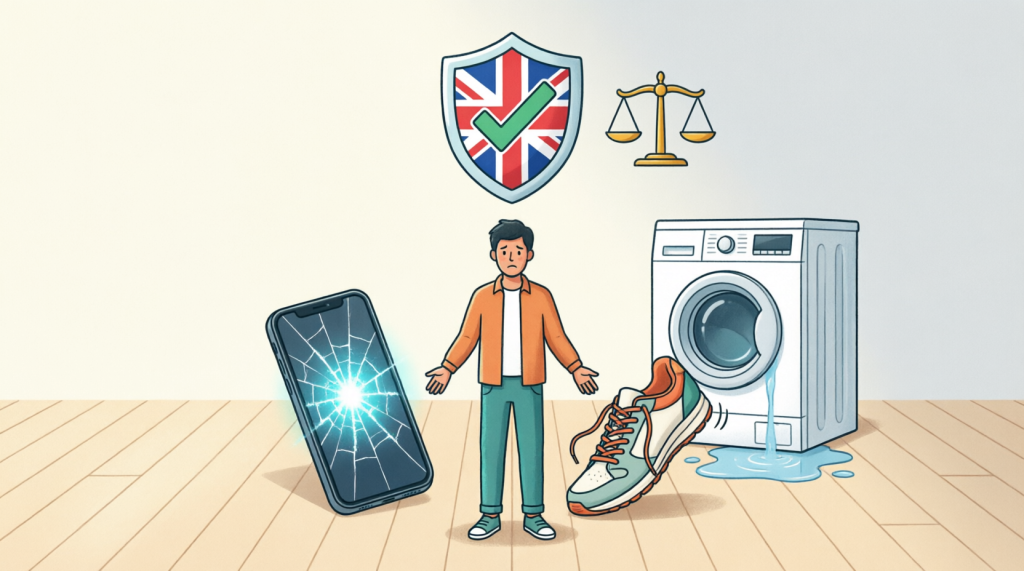
You’ve spent your hard-earned money on something you need or want, only to discover it’s faulty.
Perhaps the screen on your new mobile phone flickers uncontrollably, the sole has already separated from your brand-new shoes, or the washing machine you installed last week floods your kitchen floor.
The frustration is real – but the good news is that UK consumer law is firmly on your side.
At Impel Legal, our paralegal team deals with consumer disputes daily, and we understand how overwhelming it can feel when a retailer fobs you off, ignores your calls, or simply refuses to acknowledge that the item you purchased is defective. This article sets out your legal rights, the avenues open to you, and how we can help you secure the refund or remedy you deserve.
How Did You Purchase the Item?
Your rights as a consumer apply regardless of how you bought the faulty product, though certain additional protections may apply depending on the method of purchase. Consider the following common scenarios:
In a high-street store or shopping centre – You tried on a jacket, paid at the till, and took it home, only to find the zip breaks on the second wear.
Online – You ordered a sofa from a retailer’s website, and upon delivery, the frame is cracked, and the cushions are misshapen.
Over the telephone – You called a catalogue company to order a dining table, and it arrived with a warped surface and missing fixings.
In a closing-down or clearance sale – You bought a discounted television from a shop shutting its doors, and it powers off randomly within days.
Via a mobile app or social media marketplace – You purchased a pair of trainers through an advertised link, and the stitching unravels almost immediately.
From a market stall or pop-up shop – You bought a small kitchen appliance at a weekend market, and it sparks and stops working after one use.
Through a mail-order catalogue– You ordered a winter coat, and it arrives with a torn lining and missing buttons.
In every one of these scenarios, your statutory rights remain intact. A “closing-down sale,” “clearance,” or “sold as seen” sign does *** strip you of your legal protections if the item is inherently faulty (as opposed to you simply changing your mind). A retailer cannot contract out of the law.
Common Examples of Faulty Items We See At Impel Legal, our paralegal assists clients who have purchased a wide range of defective goods, including but not limited to:
Mobile phone / tablet | Screen defects, battery failure, software crashes |
Television/electronics | Dead pixels, no sound, intermittent power loss |
Washing machine or dishwasher | Leaking, not spinning, error codes within weeks |
Sofa / upholstered furniture | Collapsing frame, split seams, incorrect dimensions |
Dining table / chairs | Warping, unstable joints, incorrect wood type |
Shoes / boots | Sole separation, broken heel, stitching failure |
Clothing | Shrinking after one wash despite following care instructions, colour bleeding, torn seams |
Kitchen appliances (kettles, toasters, ovens) | Electrical faults, overheating, not reaching temperature |
Garden furniture / tools | Rusting within days, structural failure |
No matter the item or the price tag, the law protects you.
Your Legal Rights: The Key Legislation
Several Acts of Parliament and Regulations govern the sale of goods to consumers in the United Kingdom. When you purchase a faulty item, one or more of the following laws will typically have been breached:
1. The Consumer Rights Act 2015
This is the cornerstone of UK consumer protection and consolidates earlier legislation. Under Part 1, Chapter 2 of the Act, all goods supplied to a consumer must be:
Of satisfactory quality (Section 9) – free from defects, safe, durable, and acceptable in appearance and finish.
Fit for a particular purpose (Section 10) – if you made a specific purpose known to the seller, the item must meet that purpose.
As described (Section 11) – matching any description, sample, or model shown to you.
Matching any pre-contract information (Section 12).
If any of these requirements are not met, the goods do not conform to the contract, and you are entitled to a remedy.
2. The Consumer Contracts (Information, Cancellation and Additional Charges) Regulations 2013
If you purchased the item online, by phone, by post, or away from the trader’s premises, you benefit from a 14-day cooling-off period during which you may cancel the contract for any reason and receive a full refund. Faulty items discovered within or beyond this window are additionally protected under the Consumer Rights Act 2015.
3. The Consumer Protection from Unfair Trading Regulations 2008
If the retailer misled you about the quality, condition, or origin of the item – for example, selling a refurbished phone as “brand new” or advertising a sofa as “solid oak” when it is veneered chipboard – this constitutes a misleading action under Regulations 5 and 6, and may also amount to an aggressive commercial practice under Regulation 7.
4. The Sale of Goods Act 1979 (as amended)
While largely superseded for consumer transactions by the Consumer Rights Act 2015, this Act still underpins certain principles and remains relevant for business-to-business purchases.
5. The Supply of Goods and Services Act 1982
Relevant where the faulty item was supplied as part of a service (for example, a kitchen fitted with a defective appliance).
6. The Equality Act 2010 / General consumer protection provisions
In rarer cases where a retailer discriminates in how it handles your complaint, additional legislation may be engaged.
What Are You Entitled To? The Hierarchy of Remedies
Under the Consumer Rights Act 2015, you are not limited to a single option. The law provides a structured hierarchy of remedies:
Short-Term Right to Reject (within 30 days)
If the item is faulty at the point of sale or within 30 days of delivery, you have an automatic right to reject the goods and receive a full refund. The refund must be issued within 14 days of the trader agreeing the goods are faulty.
Right to Repair or Replacement (after 30 days, up to six months)
If you discover the fault after 30 days but within six months you may request a repair or replacement. The trader must carry this out within a reasonable time, without significant inconvenience, and at their own cost. If the repair or replacement fails, is impossible, or is disproportionate, you may then claim a price reduction (up to 100%, effectively a full refund) or exercise a final right to reject.
Beyond Six Months (up to six years / five years in Scotland)
You still have rights, but the burden shifts to you to prove the fault was inherent (i.e., present at the time of sale) rather than caused by wear and tear. Expert reports, photographs, and purchase records become important here.
Additional Remedies
– Damages for any consequential loss (e.g., a faulty washing machine that ruined your kitchen flooring).
– Delivery costs if the item was delivered to you.
– A refund of the full purchase price, not a credit note or voucher (unless you voluntarily agree).
Practical Steps to Secure Your Refund
1. Gather your evidence– receipts, bank/credit card statements, order confirmation emails, photographs or video of the fault, packaging, and any correspondence with the seller.
2. Contact the retailer first – Write (email is fine; keep a copy) stating clearly that the item is faulty, referencing the Consumer Rights Act 2015, and specifying whether you want a refund, repair, or replacement. Set a reasonable deadline (14 days is standard).
3. Escalate to the manufacturer – If the retailer is unresponsive, contact the manufacturer, particularly if a warranty or guarantee is in place. Note: a manufacturer’s warranty is in addition to, not a replacement for, your statutory rights.
4. Use a chargeback or Section 75 claim – If you paid by debit card, you may request a chargeback through your bank. If you paid by credit card and the item cost between £100 and £30,000, Section 75 of the Consumer Credit Act 1974 makes the credit card provider jointly liable.
5. Contact Trading Standards – If the trader is engaging in unfair or misleading practices, your local Trading Standards office can investigate.
6. Alternative Dispute Resolution (ADR) – Many sectors have an approved ADR or ombudsman scheme (e.g., the Furniture Ombudsman, the Electrical Safety Council, the Financial Ombudsman for credit-card disputes).
7. Issue a claim in the County Court (Small Claims Track) – For claims up to £10,000, you can issue proceedings via the Money Claim Online (MCOL) service. This is often the final step when all else fails.
Where the Paralegal at Impel Legal Can Help
Navigating consumer law can feel daunting, particularly when a large retailer or manufacturer has a dedicated legal team and you simply want your money back. This is where our paralegal team at Impel Legal steps in. We can assist you by:
Reviewing your purchase documentation and evidence to confirm which statutory rights have been breached and which legislation applies to your specific circumstances.
Drafting formal letters of complaint and letters before action that cite the relevant sections of the Consumer Rights Act 2015, the Consumer Contracts Regulations 2013, and any other applicable law, putting the trader on clear legal notice.
– Advising on the correct remedy– whether a full refund, partial refund, repair, replacement, or damages claim is most appropriate given the age of the item and the nature of the fault.- Liaising with the retailer, manufacturer, or their solicitors on your behalf, saving you time, stress, and repeated phone calls.
– Assisting with Section 75 credit-card claims and bank chargeback applications, including preparing the supporting narrative and evidence pack.
– Preparing and issuing County Court claims (including Small Claims Track) and guiding you through each procedural step, from completing the N1 claim form to attending the hearing.
– Advising on ADR and ombudsman routes helping you frame your complaint in the language the scheme expects.
– Supporting you where a retailer has used unfair contract terms, “sold as seen” disclaimers, or misleading advertising, potentially engaging the Consumer Protection from Unfair Trading Regulations 2008.
– Providing ongoing updates and plain-English explanations so you always know where your case stands and what happens next.
Our paralegal works under the supervision of qualified solicitors at Impel Legal, ensuring every piece of advice is accurate, up to date, and tailored to your situation – all at a transparent and accessible cost.
Frequently Asked Questions
The shop said I can’t get a refund because it was in a sale. Is that true?”
No. Sale items carry the same statutory rights as full-price items. The only exception is if the specific fault was drawn to your attention before you bought the item (e.g., a label reading “faulty zip – sold as seen”).
“The retailer says I have to deal with the manufacturer.”
Your contract is with the retailer, not the manufacturer. Under the Consumer Rights Act 2015, it is the trader who bears responsibility. You are entitled to pursue the seller directly.
I’ve had the item for over a year. Am I too late?”
Not necessarily. You have up to six years (five in Scotland) from the date of purchase to bring a claim. You will, however, need to demonstrate the fault was inherent.
“They offered me a credit note. Do I have to accept it?”
No. If you are exercising your statutory right to reject faulty goods, you are entitled to a monetary refund by the same method you paid. A credit note is only acceptable if you freely choose it.
Final Thoughts
A faulty item is more than an inconvenience – it represents money you should not have had to spend twice. UK consumer law is robust, and the protections afforded by the Consumer Rights Act 2015, the Consumer Contracts Regulations 2013, and the Consumer Protection from Unfair Trading Regulations 2008 exist precisely to ensure you are not left out of pocket.
You do not have to accept a shrug, a store-credit voucher, or endless hold music. You have rights, and you have options.
If you are struggling to secure a refund, repair, or replacement for a faulty item – whether it was bought online, over the phone, in a closing-down sale, or from a high-street chain – contact the paralegal team at Impel Legal today. We will assess your case, explain your rights in plain English, and fight for the outcome you deserve.
*This article is for general information purposes only and does not constitute legal advice. For advice specific to your circumstances, please contact Impel Legal directly.
Impel Legal – Your rights, protected.
- Faulty Retail Goods: Claim a refund, replacement, or repair for products that are broken or fail within 30 days using the paralegal at Impel Legal.
- Counterfeit Goods & Knockoffs: Request refunds for fake clothing, toys, or electronics via the paralegal at Impel Legal.
- Item Mismatch (Not as Described): Return goods that do not look like or act like their product listing using information from the paralegal at Impel Legal.