
Faulty Dining Suite?
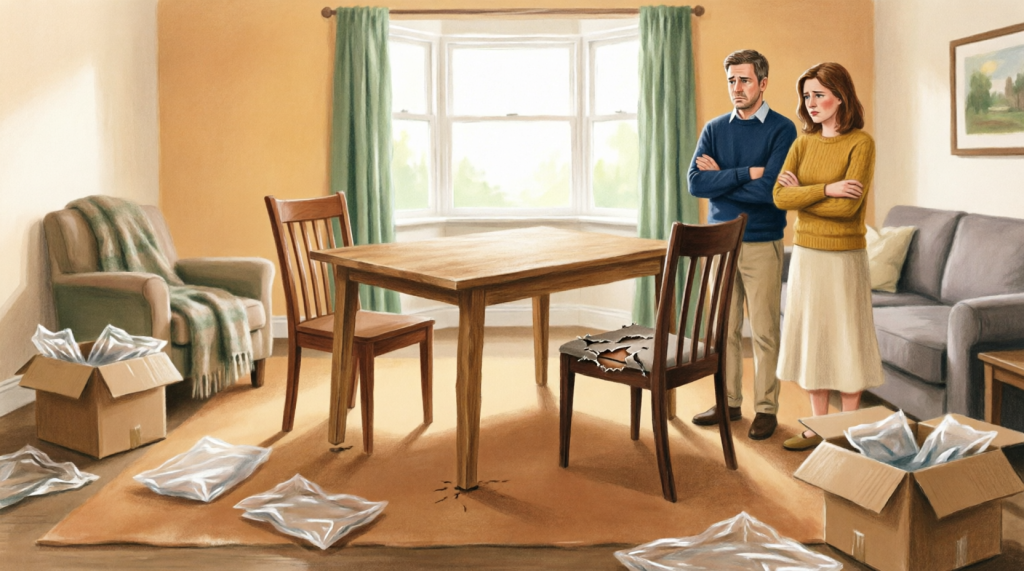
You didn’t expect a defective dining suite; you bought a brand-new, beautiful dining table and chairs, unpacked them, and discovered imperfections and damage.
You have invited guests for dinner to show off your dining suite.
How The Paralegal at Impel Legal can help
You’ve saved up, measured the room twice, scrolled through countless catalogues, and finally ordered the dining set of your dreams. The delivery van arrives, you unwrap the packaging with excitement, and then… disaster. The table wobbles. The chairs don’t match. The wood looks nothing like the brochure. The fabric on one seat is already torn.
Unfortunately, this is a far more common experience than it should be. Whether you purchased from a high-street furniture retailer, an online marketplace, a department store, or a bespoke joiner, you are entitled to receive goods that meet specific legal standards. When they don’t, you have rights – and you don’t have to fight alone.
The paralegal at Impel Legal is here to help you.
This article explores the wide spectrum of faults that can afflict a new dining table and chairs, sets out the UK legislation that protects you, and explains how The Paralegal at Impel Legal can intervene at every stage to secure the remedy you deserve.
1. Comprehensive Examples of Faults
Defective dining furniture can present in dozens of ways. Below is a non-exhaustive catalogue of issues consumers regularly encounter:
Structural & Manufacturing Defects
- Warping – The tabletop has bowed or twisted, often due to improper kiln-drying of timber, meaning plates slide and glasses topple.
- Unstable joints – Mortise-and-tenon, dowel, or glued joints are loose, wobbly, or visibly separating within days of assembly.
- Uneven or mismatched legs – One or more chair/table legs are shorter, causing persistent rocking even on a level floor.
- Splitting or cracking timber – Hairline fractures in the tabletop or chair frames that worsen with temperature changes.
- Veneer bubbling or peeling – The decorative layer lifts away from the substrate, exposing cheap chipboard underneath.
Material & Description Issues
- Incorrect wood type – Advertised as solid oak but delivered as rubberwood, pine, or MDF with an oak-effect laminate.
- Wrong colour or finish – Ordered a walnut stain; received something closer to pale beech.
- Incorrect dimensions – The table is 10 cm shorter than the listed specification, or chairs are too tall for the table apron.
- Chairs don’t match – A set of six chairs arrives with two in a noticeably different shade, grain pattern, or style.
Cosmetic & Surface Damage
- Scratches, dents, and gouges – Visible marks on the tabletop or chair backs present on delivery.
- Paint or lacquer imperfections – Drips, uneven coverage, rough patches, or areas where the finish has not adhered.
- Torn, stained, or misaligned seat fabric/leather – Upholstery rips, pulling threads, or mismatched pattern alignment.
Transit & Packaging Damage
- Damaged in transit – Crushed corners, snapped legs, cracked glass inserts, or shattered marble tops caused by inadequate courier handling.
- Missing parts or hardware – Absent bolts, dowels, Allen keys, or assembly instructions rendering the set unusable.
Functional & Safety Concerns
- Chemical off-gassing – A persistent, noxious smell from adhesives or varnishes that causes headaches or respiratory irritation.
- Sharp edges or exposed fixings – Protruding screws, splintered wood, or unfiled metal posing an injury risk, particularly to children.
- Collapse under normal use – A chair leg gives way when a person of average weight sits down, creating a genuine safety hazard.
Additional Faults
- Incorrect assembly instructions – Steps are missing, diagrams are for a different model, or hardware is labelled incorrectly.
- Faulty extendable mechanism – A butterfly-leaf or telescopic extension jams, sticks, or fails to lock in place.
- Mismatched batch numbers – Table and chairs clearly originate from different production runs, resulting in visible inconsistency.
- Premature wear – Within weeks, the finish dulls, fabric pills, or joints loosen under ordinary domestic use.
Where The Paralegal at Impel Legal intervenes: If you are unsure whether what you are looking at constitutes a genuine fault or a legal breach, The Paralegal at Impel Legal can review photographs, product listings, order confirmations, and delivery notes to assess the strength of your position before you even contact the seller. This early assessment saves time, prevents missteps, and ensures you frame your complaint in the correct legal language from the outset.
Click here to contact the paralegal at Impel Legal.
2. Scenario-Based Examples and Paralegal Intervention
Scenario A – The Warped “Solid Oak” Table
Facts: Mrs Patel ordered a 180 cm solid-oak dining table from a national furniture chain for £1,250. On delivery, the tabletop is visibly bowed by nearly 8 mm along its length. The retailer’s website described the item as “kiln-dried solid oak, hand-finished.” Upon closer inspection, Mrs Patel suspects the core is actually veneered particleboard.
Legal issue: The goods are not of satisfactory quality, not as described, and arguably not fit for purpose.
Paralegal intervention: The Paralegal at Impel Legal drafts a formal letter of rejection citing Sections 9, 10, and 11 of the Consumer Rights Act 2015, demands a full refund of £1,250, and requests collection of the item at the retailer’s cost. When the retailer offers only a £150 goodwill voucher, The Paralegal escalates the matter, threatens a County Court claim, and advises Mrs Patel on the 30-day short-term right to reject. The retailer ultimately issues a full refund.
Scenario B – Chairs Don’t Match and Joints Are Loose
Facts: Mr and Mrs Okafor bought a six-chair dining set online for £899. Four chairs are a warm honey tone; two are noticeably greyer. Within a week, three chairs develop wobbly joints, and one chair’s back rail separates entirely when leaned against.
Legal issue: Goods not as described (mismatched set) and not of satisfactory quality (structural failure under normal use).
Paralegal intervention: The Paralegal at Impel Legal advises the couple to document everything with date-stamped photographs and video. A formal complaint letter is issued requesting either a full replacement set of matching chairs or a complete refund. When the seller attempts to argue that “slight colour variation is natural in wood,” The Paralegal counters with the product listing’s explicit promise of a “uniform six-chair set” and the Consumer Contracts (Information, Cancellation and Additional Charges) Regulations 2013 regarding accurate pre-contract information. A replacement set is provided within 14 days.
Scenario C – Table Damaged in Transit
Facts: Ms Chen ordered a glass-top dining table for £649 from an online retailer. The courier delivers the boxed item; upon opening, the glass is cracked in two places and one metal leg is bent.
Legal issue: The goods are damaged and not of satisfactory quality. Under the Consumer Rights Act 2015, risk remains with the trader until the goods come into the physical possession of the consumer (Section 29).
Paralegal intervention: The Paralegal at Impel Legal advises Ms Chen to refuse to sign any “received in good condition” delivery note, photographs the damage before fully unpacking, and contacts the retailer in writing within 48 hours. The Paralegal drafts a notice requiring a replacement or refund under Section 24 of the Consumer Rights Act 2015. When the retailer tries to redirect Ms Chen to the courier, The Paralegal clarifies that the contractual obligation sits with the seller, not the delivery company. A full refund of £649 plus return-collection is arranged.
Scenario D – Torn Seat Fabric and Scratches on Delivery
Facts: Dr MacLeod purchased four upholstered dining chairs at £175 each (£700 total) from a department store. On unboxing, one chair has a 5 cm tear in the seat fabric, and two chairs have deep scratches on the wooden legs.
Legal issue: Goods are damaged and not of satisfactory quality at the point of delivery.
Paralegal intervention: The Paralegal at Impel Legal helps Dr MacLeod complete the store’s incident report correctly, ensures the faults are logged in writing (not merely a verbal assurance from a shop-floor assistant), and issues a follow-up letter asserting the right to repair, replacement, or refund. When the store offers to “patch” the fabric, The Paralegal advises that a visible repair on a brand-new item does not satisfy the statutory standard and pushes for a full replacement of all four chairs. The store complies.
Scenario E – Incorrect Wood Type and Chemical Smell
Facts: The Harrisons paid £2,400 to a bespoke furniture workshop for a “solid ash” dining table and eight chairs. The finished set arrives with a strong chemical odour that causes their young son’s asthma to flare, and an independent timber expert confirms the wood is actually cheap poplar stained to resemble ash.
Legal issue: Misrepresentation, goods not as described, not of satisfactory quality, and a potential safety concern under the General Product Safety Regulations 2005.
Paralegal intervention: The Paralegal at Impel Legal coordinates the obtaining of an independent expert report, issues a letter before action citing breach of contract under the Consumer Rights Act 2015 and misrepresentation under the Misrepresentation Act 1967, and demands a full refund of £2,400 plus the £180 expert-report fee as consequential loss. The Paralegal also advises on a complaint to Trading Standards regarding the chemical safety issue. The workshop refunds the full amount and collects the set.
Scenario F – Extendable Table Mechanism Fails and Dimensions Are Wrong
Facts: Mr Davies bought an extendable dining table advertised as 160 cm, extending to 220 cm, for £785. The table arrives measuring only 145 cm, and the extension mechanism jams after two uses, rendering it impossible to extend.
Legal issue: Goods not as described (incorrect dimensions) and not fit for purpose (extension mechanism fails under normal operation).
Paralegal intervention: The Paralegal at Impel Legal advises Mr Davies to measure the table with a witness present and to video the mechanism failing. A formal letter is sent rejecting the goods under Section 20 of the Consumer Rights Act 2015 (short-term right to reject) and demanding a full refund including the £45 original delivery charge. The retailer initially offers a repair; The Paralegal advises that because the description was fundamentally wrong, Mr Davies is entitled to reject outright rather than accept a repair. The refund is processed.
3. The UK Laws That Protect You
Several statutes and regulations form the backbone of consumer protection for defective furniture in England, Wales, Scotland, and Northern Ireland:
Consumer Rights Act 2015 (CRA 2015)
The principal legislation governing consumer purchases of goods from traders.
- Section 9 – Satisfactory quality: Goods must meet the standard a reasonable person would consider satisfactory, taking into account the description, price, and all other relevant circumstances. This covers freedom from minor defects, safety, durability, and appearance.
- Section 10 – Fitness for a particular purpose: If you made known (explicitly or implicitly) a particular purpose – e.g., “I need this table to seat eight for daily family meals” – the goods must be fit for that purpose.
- Section 11 – Goods as described: The goods must match any description, model, sample, or specification provided before purchase.
- Section 12 – Matching a model seen or examined: If you inspected a display model, the item delivered must correspond.
- Section 13 – Matching a sample: Where a sample of fabric or wood was shown, the final product must match.
- Section 29 – Passing of risk: Risk in the goods remains with the trader until they come into the physical possession of the consumer (or a person identified by the consumer to take possession). This is critical for transit-damage claims.
- Sections 19–24 – Remedies:
- Short-term right to reject (Section 20): Within 30 days of delivery/ownership, you may reject faulty goods for a full refund.
- Right to repair or replacement (Section 23): If you do not reject within 30 days, you can request a repair or replacement. The trader must do so within a reasonable time, without significant inconvenience, and at their own cost.
- Right to price reduction or final right to reject (Section 24): If repair/replacement is impossible, fails, or is not carried out within a reasonable time, you may claim a price reduction (up to 100%) or exercise the final right to reject (subject to a deduction for use if more than six months have elapsed).
Consumer Contracts (Information, Cancellation and Additional Charges) Regulations 2013
Applies to distance and off-premises sales (e.g., online furniture orders).
- Provides a 14-day cooling-off period for most distance contracts.
- Requires traders to give clear pre-contract information including main characteristics, total price, delivery costs, and complaint-handling procedures.
- If goods arrive damaged or incorrect, these regulations reinforce your right to a full refund including standard delivery charges.
Misrepresentation Act 1967
If the seller made false statements about the wood type, origin, dimensions, or quality that induced you to purchase, you may have a claim for misrepresentation (innocent, negligent, or fraudulent), potentially entitling you to rescind the contract and/or claim damages.
Consumer Protection from Unfair Trading Regulations 2008 (CPRs)
Prohibits misleading actions, misleading omissions, and aggressive commercial practices. Advertising a table as “handcrafted solid mahogany” when it is factory-made veneered MDF is a clear breach.
General Product Safety Regulations 2005
Requires all consumer products placed on the market to be safe. A chair that collapses under normal use, or a table emitting toxic fumes, may breach these regulations and should be reported to your local Trading Standards office.
Supply of Goods and Services Act 1982
Relevant where a tradesperson has been engaged to assemble, repair, or modify your dining set. The service must be carried out with reasonable care and skill, within a reasonable time, and for a reasonable charge.
Sale of Goods Act 1979 (largely superseded for consumers)
Still relevant for business-to-business transactions or second-hand private sales (where the CRA 2015 does not apply). In private sales, goods must still match their description.
Where The Paralegal at Impel Legal intervenes: Identifying which statute or combination of statutes applies to your specific facts is not always straightforward. The Paralegal at Impel Legal will map your complaint to the correct legal provisions, ensuring your demand letter or court claim cites the precise sections. This precision dramatically increases the likelihood of a swift resolution and prevents the seller from deflecting with generic “store policy” responses that carry no legal weight.
4. Your Rights to a Refund, Repair, Replacement, and Compensation
Can you claim a refund?
Yes. Your refund rights operate on a tiered timeline:
| Timeframe | Right | Key Detail |
|---|---|---|
| 0–30 days from delivery | Short-term right to reject (s.20 CRA 2015) | Full refund, including original delivery charges. The trader must collect the goods at their cost if they are too bulky to post. Refund must be issued within 14 days of the trader receiving the goods back (or evidence of return). |
| 30 days – 6 months | Right to repair/replacement, then price reduction or final rejection | If a repair or replacement fails, is refused, or causes unreasonable inconvenience, you may claim a price reduction up to 100% or exercise the final right to reject. No deduction for use in the first six months. |
| After 6 months (up to 6 years / 5 years in Scotland) | Final right to reject with possible deduction for use | The burden of proof shifts: you may need to show the fault was inherent at the time of sale (e.g., via an expert report). A reasonable deduction for the benefit you have had from the goods may be applied. |
Can you claim compensation?
In addition to a refund or replacement, you may be entitled to consequential losses, including:
- The cost of an independent expert/timber report (e.g., £150–£350).
- Additional delivery or storage charges you incurred because of the fault.
- The cost of hiring a replacement table/chairs for an event (e.g., a wedding reception at home) if the faulty set rendered your home unusable for that purpose.
- Reasonable travel costs to return the item if the seller refuses to collect.
- In misrepresentation cases, damages for the difference in value between what was promised and what was delivered.
- In rare cases involving personal injury (e.g., a chair collapses and you break a wrist), a separate personal injury claim may arise.
What about “store credit” or “goodwill vouchers”?
You are not obliged to accept a voucher, store credit, or partial discount if the law entitles you to a full refund. The Paralegal at Impel Legal routinely pushes back against retailers who attempt to substitute a £50 gift card for a statutory refund on a £900 dining set.
Where The Paralegal at Impel Legal intervenes: Calculating the correct quantum of your claim – refund, delivery charges, consequential losses, expert fees, and any applicable interest – requires care. The Paralegal at Impel Legal prepares a detailed schedule of loss, ensures you are not short-changed by “first-offer” settlements, and advises whether a deduction for use is legally permissible in your circumstances. If the seller disputes the amount, The Paralegal can negotiate on your behalf or prepare the figures for a small-claims or County Court hearing.
5. Practical Steps You Should Take
- Document everything. Photograph and video every fault from multiple angles, ideally with a date stamp and a ruler or coin for scale. Keep all packaging until the dispute is resolved.
- Preserve your paperwork. Order confirmation, receipt/invoice, product listing screenshots, email correspondence, delivery notes, and assembly instructions.
- Do not attempt repairs yourself before the seller has had a chance to inspect, as this can complicate your claim.
- Notify the seller in writing (email or letter) as soon as possible. State the fault, reference your legal rights under the CRA 2015, and specify the remedy you want (refund, replacement, or repair).
- Escalate if ignored. If the retailer’s customer-service team is unresponsive or dismissive, a formally worded letter before action carries considerably more weight.
- Consider alternative dispute resolution (ADR). Many furniture retailers are members of a trade association (e.g., the Furniture Ombudsman) or an ADR scheme.
- Report to Trading Standards if you suspect a safety issue or systemic misrepresentation.
- Keep a timeline log of every phone call, email, and interaction, noting dates, names, and what was said.
Where The Paralegal at Impel Legal intervenes: The Paralegal at Impel Legal can take over the entire correspondence process, drafting legally precise complaint letters, letters before action, and escalation notices so you do not have to spend evenings on hold with customer-service departments. The Paralegal can also liaise with ADR bodies, Trading Standards, and – if necessary – prepare and issue proceedings in the County Court (Small Claims Track for claims up to £10,000, Fast Track above that). At every stage, you have a single, knowledgeable point of contact managing the legal heavy lifting.
6. When Court Action Becomes Necessary
If the seller refuses to engage, disputes the fault, or offers an inadequate remedy, you may need to issue a claim:
- Small Claims Track (up to £10,000): Suitable for most dining-set disputes. Court fees are modest (e.g., £35–£455 depending on the claim value), and you can represent yourself or be assisted by The Paralegal.
- Fast Track (£10,001–£25,000): For higher-value bespoke sets or where multiple items are involved.
- Alternative: Statutory Demand / Mediation: Sometimes a solicitor- or paralegal-drafted letter on professional letterhead is sufficient to prompt payment without ever reaching a courtroom.
The court can award:
- A full or partial refund.
- Consequential damages.
- Interest under Section 69 of the County Courts Act 1984 (currently 8% per annum).
- Reasonable court fees and, in some cases, fixed costs.
Where The Paralegal at Impel Legal intervenes: The Paralegal at Impel Legal can prepare your N1 Claim Form, Particulars of Claim, witness statement, and bundle of evidence (photographs, correspondence, expert reports, receipts). The Paralegal can also attend hearings with you, present submissions, and handle any post-judgment enforcement if the seller delays payment. You do not need to navigate the court process alone.
7. Frequently Asked Questions
Q: The retailer says I should contact the manufacturer. Is that correct?
A: No. Your contract is with the retailer (the trader), not the manufacturer. Under the CRA 2015, the retailer bears responsibility. The Paralegal at Impel Legal will firmly redirect any such deflection.
Q: I signed a delivery note that said “received in good condition.” Have I lost my rights?
A: Not necessarily. Signing a delivery note does not extinguish your statutory rights, particularly for latent defects that are not visible through packaging. However, it can complicate matters, which is why The Paralegal at Impel Legal advises clients to inspect goods before signing wherever possible and to note “damaged” or “unchecked” on the delivery form.
Q: The fault appeared three months after delivery. Am I too late?
A: No. Within the first six months, the law presumes the fault was present at the time of sale unless the trader can prove otherwise. You retain the right to repair, replacement, or (if those fail) a price reduction or final rejection.
Q: I bought the set from a private seller on an online marketplace. Am I covered?
A: The CRA 2015 applies to trader-to-consumer sales. A one-off private sale is generally governed by the principle of caveat emptor (buyer beware), although the goods must still match their description under the Misrepresentation Act 1967 and general contract law. The Paralegal at Impel Legal can assess whether the “private seller” is in fact operating as a trader, which would bring the CRA 2015 back into play.
Q: Can I claim for the inconvenience and stress?
A: In limited circumstances, damages for distress and inconvenience may be recoverable, particularly where the seller’s conduct has been unreasonable or where the defective furniture has significantly disrupted your household (e.g., no usable dining table for weeks with young children). The Paralegal at Impel Legal will advise on whether such a head of loss is viable in your case.
8. How The Paralegal at Impel Legal Can Help – A Summary
At every stage of a defective dining table and chairs dispute, The Paralegal at Impel Legal provides:
- Initial case assessment – A confidential review of your purchase documents, photographs, and correspondence to confirm your legal position.
- Letter drafting – Professionally worded complaint letters, letters before action, and statutory notices citing the precise sections of the CRA 2015 and related legislation.
- Negotiation – Direct liaison with the retailer, their legal team, or their insurer to secure a refund, replacement, or compensation without court proceedings.
- Expert coordination – Arranging independent timber, upholstery, or structural reports where the seller disputes the fault.
- ADR and ombudsman complaints – Preparing and submitting complaints to the Furniture Ombudsman, Trading Standards, or relevant trade-body arbitration schemes.
- Court preparation and representation – Drafting claim forms, particulars of claim, witness statements, and bundles; attending County Court hearings.
- Post-judgment enforcement – If a judgment is obtained but the seller delays payment, The Paralegal can initiate enforcement steps such as a warrant of execution or a charging order.
- Ongoing advice – Answering your questions at every step so you are never left guessing what happens next.
You do not need to accept a substandard dining set, a dismissive customer-service script, or a token voucher when the law is firmly on your side.
Disclaimer
The content of this article is provided for general informational and educational purposes only and does not constitute legal advice. While every effort has been made to ensure the accuracy of the legal references and guidance as at the date of publication, laws and regulations are subject to change. The information contained herein should not be relied upon as a substitute for tailored legal advice specific to your individual circumstances.
The Paralegal at Impel Legal endeavours to keep all information up to date; however, no warranty or representation is given as to the completeness, accuracy, or currency of the content. Reading this article does not create a paralegal–client or solicitor–client relationship. Any action you take, or refrain from taking, on the basis of this article is done entirely at your own risk.
For advice specific to your situation, please contact The Paralegal at Impel Legal directly. If your matter involves a personal injury, a safety hazard, or a dispute value exceeding the Small Claims Track limit, you may require the services of a solicitor, and The Paralegal at Impel Legal will advise you accordingly.
This article is governed by the laws of England and Wales. If you reside in Scotland or Northern Ireland, certain procedural and legislative differences may apply.
© Impel Legal. All rights reserved. Unauthorised reproduction of this article in whole or in part is prohibited.
If your new dining table and chairs are not what they should be, do not suffer in silence. Contact The Paralegal at Impel Legal today for a confidential, no-obligation initial discussion and let us help you secure the remedy you are entitled to under the law.