
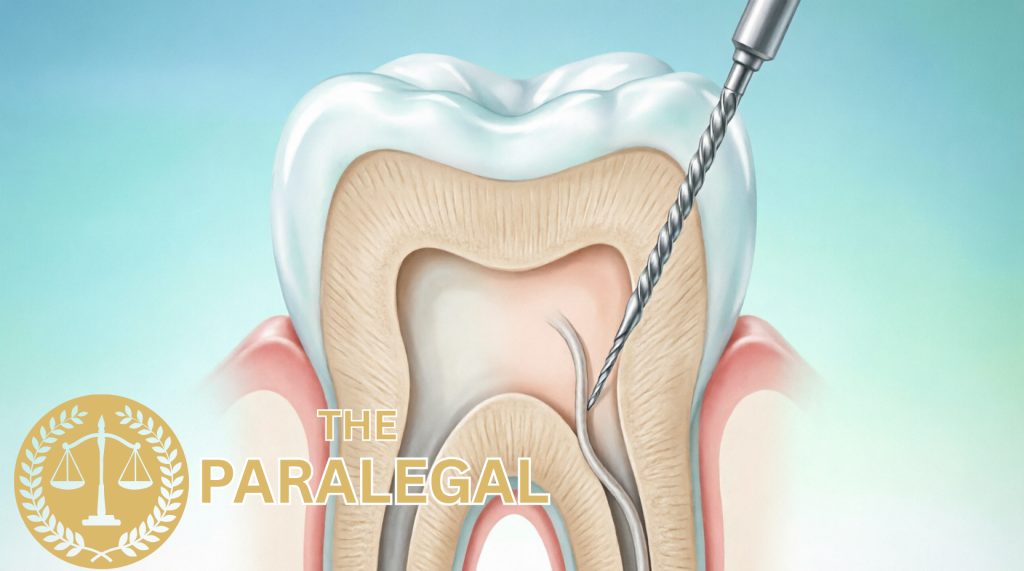
Yes, you can sue a dentist for a poor root canal treatment.
Before you consider suing your dentist for root canal issues, you must follow a proper, coordinated process.
The small claims court will not look upon your case favourably if you don’t follow due process.
The paralegal at Impel legal can help guide you through the root canal complaints process. Click here to contact the paralegal at Impel Legal.
Root Canal Complaints, Legal Rights & Compensation
| Can I sue my dentist | Bad root canal | Bad crown | Lockjaw |
A root canal treatment (endodontic treatment) is a dental procedure designed to save a tooth that has become infected or severely damaged. It involves removing the infected pulp from within the tooth, cleaning and shaping the root canals, and then filling and sealing them. While the procedure is routine for experienced dental professionals, when it goes wrong, the consequences can be severe – ranging from persistent pain and infection to tooth loss, nerve damage, and the need for costly corrective treatment.
If you have suffered as a result of a poorly performed root canal, you may be wondering: Can I sue my dentist? The short answer is yes – but the process, your rights, and the avenues available to you depend on the specific circumstances of your case.
This comprehensive guide explains your legal rights, the faults that may give rise to a claim, the UK legislation that protects you, and how The Paralegal at Impel Legal can intervene at every stage to help you secure the outcome you deserve.
Section 1: Common Faults in Root Canal Treatment
Root canal treatment requires precision, skill, and adherence to established clinical protocols. When a dentist or endodontist fails to meet the required standard of care, a number of specific faults may occur. Below are comprehensive examples:
1.1 Incomplete Removal of Infected Pulp
The dentist fails to remove all of the infected or necrotic tissue from the root canal system. This can leave bacteria trapped within the tooth, leading to persistent or recurring infection, abscess formation, and ongoing pain.
1.2 Perforation of the Root or Pulp Floor
During the procedure, the dentist drills through the wall of the root canal or the floor of the pulp chamber, creating an artificial hole (perforation). This can cause bleeding, infection, bone loss around the tooth, and often renders the tooth unrestorable.
1.3 Broken or Retained Instruments
A file, reamer, or other endodontic instrument snaps off inside the root canal and is left in situ without the patient being informed. Retained instruments can harbour bacteria, cause inflammation, and complicate any future retreatment.
1.4 Missed Canals
The dentist fails to identify and treat all root canals within the tooth. For example, a molar may have three or four canals, but the dentist only treats two. The untreated canal becomes a reservoir for infection.
1.5 Overfilling or Underfilling the Canal
The filling material (typically gutta-percha) is pushed beyond the apex of the root (overfill), potentially irritating or damaging surrounding tissues, nerves, or the sinus cavity. Alternatively, underfilling leaves voids where bacteria can proliferate.
1.6 Failure to Diagnose or Refer
The dentist proceeds with a root canal when the tooth was actually cracked beyond repair, or when the condition warranted extraction or referral to a specialist endodontist. Conversely, the dentist may fail to recognise that a root canal was needed at all, allowing the infection to spread.
1.7 Inadequate Anaesthesia or Pain Management
The procedure is carried out without sufficient local anaesthetic, causing the patient extreme pain and distress. In some cases, the dentist may ignore a patient’s reported allergies or medical history.
1.8 Failure to Obtain Informed Consent
The dentist does not adequately explain the risks, alternatives, and likely outcomes of the root canal before proceeding. The patient is not given the opportunity to make an informed decision.
1.9 Post-Operative Negligence
After the procedure, the dentist fails to provide appropriate aftercare instructions, does not schedule necessary follow-up appointments, or dismisses the patient’s reports of complications such as swelling, persistent pain, or signs of infection.
1.10 Damage to Adjacent Teeth or Structures
During the procedure, the dentist damages neighbouring teeth, the jawbone, or the inferior alveolar nerve, causing numbness, tingling, or chronic pain (paraesthesia or dysaesthesia).
1.11 Use of Substandard or Contaminated Materials
The dentist uses expired, substandard, or contaminated filling materials, irrigants, or instruments, increasing the risk of infection or adverse reaction.
1.12 Failure to Take or Properly Interpret Radiographs (X-rays)
The dentist does not take adequate pre-operative or post-operative X-rays, or misreads them, leading to incorrect treatment planning.
How the Paralegal at Impel Legal can intervene: The Paralegal at Impel Legal can review your dental records, radiographs, and treatment notes to identify which specific fault or combination of faults occurred. They will liaise with independent dental experts to obtain a professional opinion on whether the standard of care was breached, and will compile a comprehensive evidential file detailing every deficiency in your treatment.
Section 2: Scenarios – How Faults Play Out in Real Life
Scenario A: The Missed Canal
Mrs Thompson, 54, visited her NHS dentist in Manchester complaining of severe pain in her lower right molar. The dentist performed a root canal but only treated two of the three canals. Over the following six months, Mrs Thompson experienced recurring abscesses, was prescribed three courses of antibiotics, and eventually required extraction of the tooth and a £2,800 dental implant at a private clinic.
How The Paralegal at Impel Legal can intervene: The Paralegal at Impel Legal would obtain Mrs Thompson’s full NHS dental records, instruct an independent endodontist to confirm the missed canal constituted a breach of the standard of care, and pursue a clinical negligence claim to recover the cost of the implant, ongoing treatment, pain and suffering, and loss of amenity.
Scenario B: The Broken File
Mr Davies, 38, underwent a root canal at a private dental practice in Bristol. During the procedure, a small endodontic file fractured inside the canal. The dentist did not inform Mr Davies of the incident. Eight months later, Mr Davies developed a painful swelling. A specialist discovered the retained file and significant periapical infection. Mr Davies required apicoectomy surgery costing £1,950.
How The Paralegal at Impel Legal can intervene: The Paralegal at Impel Legal would investigate the failure to disclose the broken instrument (a breach of the duty of candour), gather expert evidence on the standard of care during the procedure, and pursue a claim for the cost of corrective surgery, pain and suffering, and any loss of earnings during recovery.
Scenario C: Perforation and Nerve Damage
Ms Okafor, 45, attended a dental clinic in London for a root canal on a lower premolar. The dentist perforated the root and, during the procedure, caused damage to the inferior alveolar nerve. Ms Okafor was left with permanent numbness on the left side of her lower lip and chin, affecting her ability to eat, speak confidently, and work as a teaching assistant.
How The Paralegal at Impel Legal can intervene: The Paralegal at Impel Legal would arrange an independent neurological and dental assessment, quantify the impact on Ms Okafor’s quality of life and earning capacity, and pursue a substantial claim for general damages (pain, suffering, and loss of amenity) and special damages (loss of earnings, future care, and ongoing treatment).
Scenario D: Failure to Obtain Consent
Mr Patel, 62, agreed to a filling but was told mid-appointment that a root canal was necessary. The dentist proceeded immediately without explaining the risks, alternatives (including extraction or monitoring), or the likelihood of success. Mr Patel suffered complications and later stated he would have chosen extraction had he been properly informed.
How The Paralegal at Impel Legal can intervene: The Paralegal at Impel Legal would assess the claim under the principles established in Montgomery v Lanarkshire Health Board [2015], obtain expert evidence on what a reasonable patient would have been told, and pursue a claim based on lack of informed consent.
Scenario E: Post-Operative Negligence
Mrs Clarke, 29, had a root canal at an NHS practice in Leeds. Within 48 hours she developed severe swelling and fever. She contacted the practice three times over a week but was told to “take over-the-counter painkillers.” By the time she was seen by another dentist, the infection had spread, requiring hospital admission, intravenous antibiotics, and drainage of a facial abscess.
How The Paralegal at Impel Legal can intervene: The Paralegal at Impel Legal would document the timeline of Mrs Clarke’s contact with the practice, obtain hospital records, instruct an expert to confirm the delay in treatment worsened her condition, and pursue a claim for the additional suffering, hospitalisation costs, and any scarring.
Section 3: UK Laws and Legal Frameworks Governing Dental Negligence Claims
Several statutes, regulations, and common law principles underpin your right to bring a claim following a bad root canal:
3.1 The Consumer Rights Act 2015
Where you receive private dental treatment, the service is governed by the Consumer Rights Act 2015. Specifically:
-
- Section 49 – The service must be performed with reasonable care and skill.
-
- Section 50 – Information provided about the service (including risks and outcomes) is binding.
-
- Section 51 – The price must be reasonable where it has not been agreed in advance.
-
- Section 52 – The service must be performed within a reasonable time.
If the dental service falls below these standards, you are entitled to remedies including repeat performance (repair/retreatment) or a price reduction (refund).
3.2 The Supply of Goods and Services Act 1982 (Part II)
Although largely superseded by the Consumer Rights Act 2015 for consumer contracts, this Act still has relevance in certain business-to-business contexts and older contractual arrangements. It implied a term that services would be carried out with reasonable care and skill.
3.3 The Common Law of Negligence
The foundational legal test derives from:
-
- Bolam v Friern Hospital Management Committee [1957] – A professional is negligent if they fail to act in accordance with a practice accepted as proper by a responsible body of professionals skilled in that field.
-
- Bolitho v City and Hackney Health Authority [1997] – The court must be satisfied that the body of professional opinion relied upon has a logical basis.
-
- Montgomery v Lanarkshire Health Board [2015] – A clinician must take reasonable care to ensure the patient is aware of any material risks involved in a proposed treatment and of reasonable alternatives.
3.4 The Limitation Act 1980
You generally have three years from the date of the negligent treatment, or from the date you first became aware (or could reasonably have become aware) that you suffered harm as a result, to issue court proceedings. For children, the three-year period does not begin until their 18th birthday. For individuals lacking mental capacity, time does not run until capacity is regained.
3.5 The NHS Act 2006 and NHS Complaints Regulations
If your treatment was provided on the NHS, you have the right to make a formal complaint under the Local Authority Social Services and National Health Service Complaints (England) Regulations 2009. You may also pursue a clinical negligence claim against the NHS trust or the individual practitioner.
3.6 The General Dental Council (GDC) Standards
The GDC’s Standards for the Dental Team sets out professional obligations including:
-
- Obtaining valid consent
-
- Maintaining patient records
-
- Raising concerns if patient safety is at risk
-
- The duty of candour (being open and honest when things go wrong)
A breach of GDC standards does not automatically constitute legal negligence, but it is strong supporting evidence.
3.7 The Human Rights Act 1998
In limited circumstances (particularly involving NHS treatment), Article 2 (right to life) and Article 8 (right to respect for private and family life, which encompasses physical integrity) of the European Convention on Human Rights, incorporated by the Human Rights Act 1998, may be engaged.
3.8 The Mental Capacity Act 2005
Where a patient lacked capacity to consent to the root canal, the provisions of this Act govern whether the treatment was lawfully administered.
3.9 The Consumer Protection Act 1987
In the rare event that a defective product (e.g., a faulty filling material or contaminated irrigant) caused your injury, you may have a claim under this Act against the manufacturer or supplier.
How The Paralegal at Impel Legal can intervene: The Paralegal at Impel Legal will identify which legal frameworks apply to your specific circumstances, ensure all limitation deadlines are met, draft letters of claim citing the relevant statutory provisions and case law, and ensure your claim is properly pleaded under the correct legal basis. They will advise whether your claim falls under NHS or private treatment routes and ensure the appropriate procedural rules are followed.
Section 4: Consumer Protection – Repair, Refund, and Compensation
As a consumer of dental services, you are protected by law. Here is how those protections translate into practical remedies:
4.1 Repair (Repeat Performance / Corrective Treatment)
Under Section 55 of the Consumer Rights Act 2015, if a service does not conform to the contract (i.e., it was not carried out with reasonable care and skill), you have the right to require the trader to repeat performance of the service to complete it properly. In dental terms, this means:
-
- The dentist may be required to retreat the root canal correctly.
-
- If the original dentist is unable or unsuitable to perform the corrective work, the cost of having another dentist or specialist carry out the repair can be recovered.
4.2 Refund (Price Reduction)
Under Section 56 of the Consumer Rights Act 2015, if repeat performance is impossible, inappropriate, or not completed within a reasonable time, you are entitled to a price reduction. This can be up to 100% of the price paid. In practice:
-
- If you paid £650 for a root canal that was performed negligently and the tooth ultimately had to be extracted, you may be entitled to a full refund of the £650.
-
- If the treatment was partially successful but deficient, a proportionate refund may apply.
4.3 Compensation (Damages)
Beyond repair and refund, you may be entitled to compensation (damages) in a clinical negligence claim. Damages are split into two categories:
General Damages (Pain, Suffering, and Loss of Amenity):
-
- Compensation for physical pain endured during and after the procedure.
-
- Psychological impact (anxiety, dental phobia, loss of confidence).
-
- Loss of enjoyment of daily activities (eating, speaking, socialising).
Special Damages (Financial Losses):
-
- Cost of corrective or remedial treatment (e.g., retreatment, extraction, implant, bridge).
-
- Prescription costs, travel to appointments, and loss of earnings.
-
- Future treatment costs (e.g., if an implant will need replacing in 15–20 years).
-
- Care and assistance provided by family members.
4.4 NHS-Specific Routes
For NHS treatment, you can:
-
- Make a formal complaint through the NHS complaints procedure.
-
- Contact the NHS England or the relevant Integrated Care Board.
-
- Pursue a clinical negligence claim through the courts (often against the NHS trust).
-
- Report the dentist to the General Dental Council if there are fitness-to-practise concerns.
4.5 Private Treatment – Additional Protections
For private treatment, in addition to the Consumer Rights Act 2015, you may also:
-
- Complain to the Dental Complaints Service (DCS), which provides a free dispute-resolution service.
-
- Pursue a civil claim for breach of contract and/or negligence.
-
- Report concerns to the GDC.
-
- Contact your credit card provider under Section 75 of the Consumer Credit Act 1974 if the treatment cost between £100 and £30,000 and was paid by credit card, as the card issuer shares liability.
How The Paralegal at Impel Legal can intervene: The Paralegal at Impel Legal will assess the full extent of your losses and entitlements. They will calculate a comprehensive schedule of special damages, obtain quotes for corrective treatment, secure medical and dental expert reports to quantify general damages, and negotiate with the dentist’s indemnity insurer or the NHS Resolution to secure a fair settlement. If a fair settlement cannot be reached, The Paralegal at Impel Legal will prepare your case for court proceedings, ensuring you claim every penny of repair cost, refund, and compensation to which you are entitled.
Section 5: The Claims Process – Step by Step
Understanding the process can reduce anxiety. Here is what typically happens:
-
- Initial Assessment – You contact The Paralegal at Impel Legal, who will conduct a free initial consultation to establish whether you have a viable claim.
-
- Gathering Evidence – Dental records, radiographs, photographs, correspondence, and witness statements are obtained.
-
- Independent Expert Report – An independent dentist or endodontist reviews the records and provides an opinion on whether the standard of care was breached and what harm resulted.
-
- Letter of Claim / Letter Before Action – A detailed letter is sent to the dentist, practice, or NHS trust setting out the allegations, the legal basis, and the losses suffered. Under the Pre-Action Protocol for the Resolution of Clinical Disputes, the defendant has 14 days to acknowledge and three months to investigate and respond.
-
- Negotiation / Alternative Dispute Resolution – The Paralegal at Impel Legal will negotiate a settlement. Mediation or the Dental Complaints Service may be explored.
-
- Court Proceedings (if necessary) – If the matter cannot be resolved, proceedings are issued in the County Court (for claims up to £100,000) or the High Court (for claims above £100,000). The Paralegal at Impel Legal will manage all procedural steps, including filing, disclosure, witness statements, and trial preparation.
-
- Settlement or Trial – The majority of clinical negligence claims settle before trial. If a trial is required, The Paralegal at Impel Legal will ensure you are fully prepared and represented.
How The Paralegal at Impel Legal can intervene: The Paralegal at Impel Legal manages every stage of this process on your behalf. From the first phone call to the final settlement or judgment, they handle all correspondence, adhere to court deadlines, instruct counsel where necessary, and keep you informed in plain English at every step. You do not need to navigate the legal system alone.
Section 6: Time Limits and Practical Considerations
-
- Three-year limitation period – Under the Limitation Act 1980, you must issue court proceedings within three years of the date of negligence or the date of knowledge of the injury. Do not delay.
-
- Preserve evidence – Keep all dental records, receipts, prescriptions, photographs of swelling or damage, and notes of conversations with the dental practice.
-
- Do not agree to informal “fixes” without advice – Some dentists may offer to retreat the tooth for free. While this may be appropriate in some cases, accepting this without legal advice could prejudice a later claim for compensation.
-
- Report concerns – You can report a dentist to the GDC if you believe their conduct poses a risk to other patients. This is separate from a compensation claim.
How The Paralegal at Impel Legal can intervene: The Paralegal at Impel Legal will advise you immediately on limitation deadlines to ensure your claim is not time-barred. They will guide you on preserving evidence, advise you before you accept any offer of remedial treatment from the dentist, and manage all communications with the practice or insurer so you are not pressured into an inadequate settlement.
Section 7: Funding Your Claim
-
- No Win, No Fee (Conditional Fee Agreement) – The Paralegal at Impel Legal can discuss whether your claim is suitable for a Conditional Fee Agreement, meaning you pay nothing upfront and legal fees are only recovered if your claim succeeds. Click here to contact the Paralegal at Impel Legal
-
- Legal Expenses Insurance – Check your home or car insurance policies; many include legal expenses cover that may fund a dental negligence claim.
-
- NHS Claims – If your treatment was NHS-funded, the claim is typically brought against the NHS trust and handled through NHS Resolution. You will not be sued personally by the NHS, and the process is funded by the public purse.
-
- Legal Aid – In very limited circumstances, Legal Aid may be available, though this is rare for dental negligence claims.
How The Paralegal at Impel Legal can intervene: The Paralegal at Impel Legal will advise you transparently on all funding options available to you, ensure there are no hidden costs, and structure the claim in the most cost-effective way. They will check your insurance policies for legal expenses cover and advise on the merits of a Conditional Fee Agreement. Click here to contact the Paralegal at Impel Legal
Section 8: Frequently Asked Questions
Q: I had my root canal on the NHS. Can I still claim compensation?
A: Yes. NHS patients have the same right to claim clinical negligence compensation as private patients. The claim is typically brought against the NHS trust or the relevant dental body.
Q: The dentist says the complication was a “known risk.” Does that mean I have no claim?
A: Not necessarily. Even known risks must be properly explained to you (informed consent under Montgomery). Furthermore, a complication arising from substandard technique is different from an inherent risk of a properly performed procedure. The Paralegal at Impel Legal will obtain an expert opinion to distinguish between the two.
Q: How much compensation can I expect?
A: Compensation varies enormously depending on the severity of the injury, the impact on your life, and your financial losses. Minor cases involving temporary pain and a straightforward retreatment might attract a few thousand pounds. Severe cases involving nerve damage, multiple surgeries, and loss of earnings can result in awards of £50,000 or more. The Paralegal at Impel Legal will provide a realistic estimate based on your individual circumstances. Click here to contact the Paralegal at Impel Legal
Q: Will I have to go to court?
A: The vast majority of dental negligence claims settle before trial through negotiation or mediation. However, The Paralegal at Impel Legal will prepare your case to trial standard from the outset, ensuring the defendant takes your claim seriously.
How The Paralegal at Impel Legal can intervene: The Paralegal at Impel Legal is available to answer all your questions in plain, jargon-free language. They will provide honest, realistic advice on the strengths and weaknesses of your claim and will never pressure you into pursuing litigation if it is not in your best interests. Click here to contact the Paralegal at Impel Legal
Section 9: Why Choose The Paralegal at Impel Legal?
The Paralegal at Impel Legal brings specialist knowledge of dental and clinical negligence law. They offer:
-
- A compassionate, client-centred approach
-
- Expertise in both NHS and private dental claims
-
- Access to a network of independent dental and medical experts
-
- Transparent funding arrangements
-
- Tenacious negotiation with insurers and NHS Resolution
-
- Clear, regular communication throughout the life of your claim
Whether you are seeking a refund for a failed root canal, corrective treatment, or substantial compensation for lasting harm, The Paralegal at Impel Legal is equipped to fight your corner.
Disclaimer
The information contained in this article is provided for general informational and educational purposes only. It does not constitute legal advice, and no solicitor-client relationship is created by reading this article. Every case is unique, and the information provided here may not apply to your specific circumstances. UK law is subject to change, and the accuracy of the information cannot be guaranteed. You should seek independent, professional legal advice tailored to your individual situation before making any decisions. The Paralegal at Impel Legal accepts no liability for any loss, damage, or inconvenience arising from reliance on the information contained in this article. If you believe you have a dental negligence claim, please contact The Paralegal at Impel Legal directly for a personalised assessment. References to legislation, case law, and regulatory standards are correct at the time of writing but may be subject to amendment or reinterpretation by the courts. Click here to contact the Paralegal at Impel Legal
© The Paralegal at Impel Legal. All rights reserved.
For a confidential, no-obligation consultation, contact The Paralegal at Impel Legal today. Click here to contact the Paralegal at Impel Legal