
Faulty Dishwasher: Your Rights
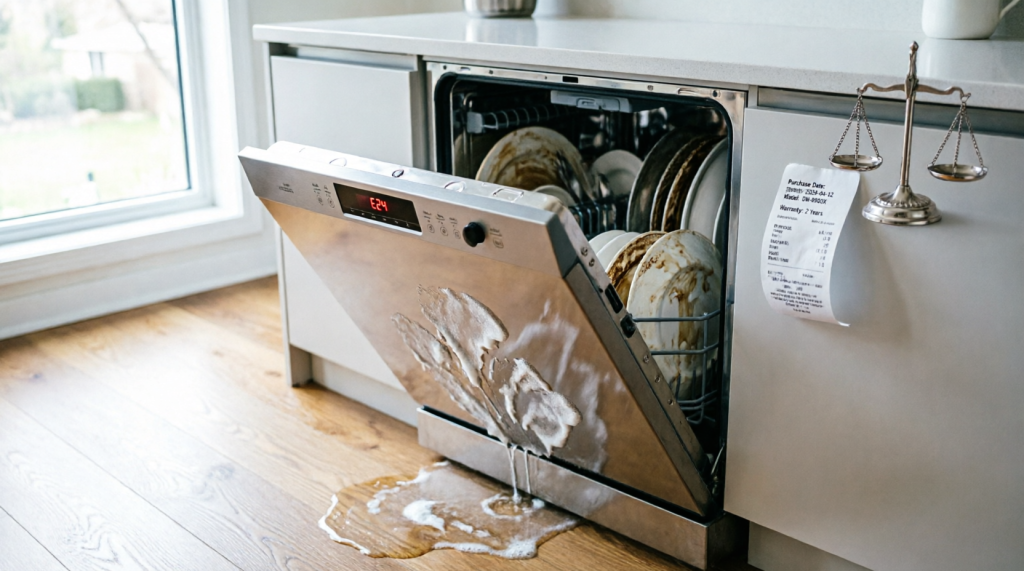
What are your legal rights after investing in a brand-new dishwasher only to discover, within days or weeks, that it is leaking across your kitchen floor, leaving plates coated in grease, failing to rinse detergent residue, or flashing cryptic error codes that render the machine useless?
You paid good money for an appliance that should work flawlessly. You deserve a product that is fit for purpose, of satisfactory quality, and as described. When it is not, the law is firmly on your side. Click here to contact the paralegal at Impel Legal.
This article explores the many ways a new dishwasher can prove defective, the UK legislation that protects you, the remedies available—including full refunds and compensation—and, crucially, how The Paralegal at Impel Legal can intervene at every stage to ensure your rights are enforced.
1. Common Ways a New Dishwasher Proves Defective
A defective dishwasher rarely announces itself in a single dramatic fashion. More often, the faults accumulate or manifest in different ways depending on the manufacturing or design flaw. Below are the principal categories of defect:
1.1 Leaking
- Door seal failure: The rubber gasket around the door is warped, split, or improperly seated from the factory, causing water to pool on the kitchen floor during every cycle.
- Cracked internal tub or sump: A hairline fracture in the plastic basin, invisible to the naked eye, weeps water steadily during operation.
- Loose or misaligned hose connections: The inlet or drain hose was not correctly fitted at the manufacturing stage, causing intermittent leaks beneath the unit.
- Faulty pump housing: The circulation or drain pump casing is cracked, spraying water internally and eventually seeping externally.
- Overfill due to a defective float switch or water-level sensor: The machine takes on too much water, overflowing from the door seal or vent.
1.2 Not Washing Properly
- Blocked or defective spray arms: Manufacturing debris (plastic shavings, packaging fragments) obstructs the spray-arm jets, resulting in poor water distribution.
- Faulty heating element: The water never reaches the required temperature, so grease and baked-on food remain on crockery.
- Defective circulation pump: Insufficient water pressure means the upper rack, in particular, emerges unchanged.
- Software/firmware fault: The wash programme terminates prematurely, cutting the cycle short by several minutes.
1.3 Not Rinsing
- Faulty rinse-aid dispenser: The mechanism fails to release rinse aid, leaving a cloudy film and water spots.
- Blocked rinse jets or a kinked internal rinse hose: Water cannot reach all surfaces during the rinse phase.
- Drain pump malfunction: Dirty wash water is not fully expelled before the rinse cycle begins, re-contaminating the load.
- Control-board error: The machine skips the rinse stage entirely, progressing straight to a spin/dry phase.
1.4 Error Codes Within Weeks
- E1/E01 – Water inlet fault: The inlet valve is defective or the flow sensor misreads, triggering an immediate shutdown.
- E3/E03 – Heating fault: The thermistor or heating element fails, and the machine refuses to proceed.
- E5/E05 – Drain fault: The pressure switch or drain pump is faulty, causing the programme to abort.
- E9/E09 – Control-board or communication fault: The PCB has a cold solder joint or firmware corruption, producing random, recurring error codes.
- F-series or flashing-light sequences: Manufacturer-specific codes indicating sensor failures, door-lock faults, or motor issues that appear within the first few weeks of ownership.
2. Realistic Scenarios: How Defects Play Out in Practice
Scenario A – The Kitchen-Floor Flood (Leaking)
Sarah, a primary-school teacher in Manchester, purchased a £549 integrated dishwasher from a national retailer. On the third use, she noticed a thin stream of water escaping from beneath the door. By the fifth use, the leak had worsened, warping her laminate flooring and damaging the plinth of an adjacent cabinet. The retailer’s helpline told her to “wait for an engineer” with a four-week lead time.
How The Paralegal at Impel Legal can intervene:
The Paralegal at Impel Legal can draft a formal letter before action to the retailer, citing breach of the Consumer Rights Act 2015, demanding an immediate repair, replacement, or full refund of the £549 purchase price, together with a claim for consequential damage to the flooring and cabinetry. If the retailer delays, The Paralegal can escalate the matter to the Small Claims Track of the County Court or initiate an Alternative Dispute Resolution (ADR) complaint, ensuring Sarah is not left out of pocket while waiting weeks for an engineer.
Scenario B – Greasy Plates Every Time (Not Washing)
James, a restaurant manager in Leeds, bought a £799 freestanding dishwasher for his home. From the very first cycle, glasses and plates emerged with visible grease and food residue. He cleaned the filters, used a different detergent, and ran a machine-clean cycle—nothing changed. The retailer insisted the machine had “passed its factory test” and refused a refund, offering only a £75 call-out fee for an engineer.
How The Paralegal at Impel Legal can intervene:
The Paralegal at Impel Legal can advise James that, under Section 9 of the Consumer Rights Act 2015, goods must be of satisfactory quality and fit for purpose. The Paralegal can prepare a Section 20 rejection notice within the 30-day short-term right-to-reject window, demanding a full refund of £799 plus reimbursement of the £75 call-out fee. Should the retailer refuse, The Paralegal can file a claim in the Small Claims Court and represent James at any hearing.
Scenario C – Cloudy Glasses and Soapy Residue (Not Rinsing)
Priya, a new homeowner in Birmingham, installed a £429 dishwasher purchased online. After the first week, every glass came out streaked with white film and tasted faintly of detergent. The rinse-aid compartment appeared full but never dispensed. The online retailer’s chatbot directed her to a troubleshooting page and then closed the conversation.
How The Paralegal at Impel Legal can intervene:
The Paralegal at Impel Legal can intervene by sending a formal complaint letter to the online retailer, referencing the Consumer Contracts (Information, Cancellation and Additional Charges) Regulations 2013 and the Consumer Rights Act 2015. The Paralegal will demand a repair or replacement within a reasonable time and, if the fault is inherent, exercise the right to a price reduction or final rejection. The Paralegal can also advise Priya on lodging a complaint with the retailer’s approved ADR scheme or, failing that, issuing a County Court claim.
Scenario D – Error Code E9 After Ten Days (Electronic Fault)
Tomás, a graphic designer in Bristol, spent £1,099 on a premium smart dishwasher. On day ten, the display flashed “E9 – Control Board Error” and the machine locked mid-cycle with hot water inside. The manufacturer’s warranty terms stated he must ship the control board to a service centre at his own cost and wait up to 28 days.
How The Paralegal at Impel Legal can intervene:
The Paralegal at Impel Legal can challenge the manufacturer’s attempt to shift the burden of remedy onto the consumer. Under the Consumer Rights Act 2015, the retailer—not the manufacturer—bears primary responsibility for faulty goods. The Paralegal can write to both the retailer and the manufacturer, insisting on an on-site repair at no cost to Tomás, or a like-for-like replacement. If the retailer hides behind the manufacturer’s warranty terms, The Paralegal can issue proceedings for breach of statutory rights and seek damages for loss of use (e.g., the cost of hand-washing or using a laundrette for 28 days).
Scenario E – Combined Failures and Consequential Damage
Elena, a retired nurse in Glasgow, purchased a £649 dishwasher from a department store. Within three weeks the machine leaked (damaging her engineered-oak floor, repair cost £1,200), failed to rinse (ruining a set of crystal glassware worth £350), and then displayed an E5 drain error. The store offered a replacement machine but refused to cover the floor or glassware.
How The Paralegal at Impel Legal can intervene:
The Paralegal at Impel Legal can advise Elena that, in addition to the statutory remedies for the defective appliance, she is entitled to claim consequential losses under Section 19 of the Consumer Rights Act 2015 and general contract-law principles (Hadley v Baxendale [1854]). The Paralegal can quantify the total loss (£649 + £1,200 + £350 = £2,199), draft a comprehensive letter of claim, and, if the department store does not settle within 14 days, issue a claim in the County Court for the full sum plus interest under Section 69 of the County Courts Act 1984.
3. The UK Laws That Protect You
Several statutes and regulations work together to shield consumers from defective appliances:
3.1 Consumer Rights Act 2015 (CRA 2015)
This is the cornerstone of consumer protection for goods purchased on or after 1 October 2015.
| Section | Protection |
|---|---|
| s.9 | Goods must be of satisfactory quality (free from defects, safe, durable, and fit for common purpose). |
| s.10 | Goods must be fit for any particular purpose made known to the seller. |
| s.11 | Goods must be as described (including any model-specific features advertised). |
| s.12 | Goods must match any sample or model seen before purchase. |
| s.19 | Consumer’s right to enforce terms about quality, fitness, and description. |
| s.20 | Short-term right to reject – a full refund within 30 days of delivery if goods are faulty. |
| s.22 | Right to repair or replacement if the 30-day window has passed. |
| s.23 | If repair/replacement fails or is impossible, the consumer may claim a price reduction (up to 100 %) or exercise the final right to reject. |
| s.24 | The burden of proof for the first six months: any fault that appears is presumed to have existed at the time of delivery unless the trader can prove otherwise. |
3.2 Consumer Protection Act 1987 (CPA 1987)
Where a defective product causes personal injury or damage to other property (e.g., a leaking dishwasher ruins flooring or causes an electrical fire), Part I of the CPA 1987 imposes strict liability on the producer, importer, or own-brander. The consumer need not prove negligence—only that the product was defective and that the defect caused the damage. Claims must generally exceed £275 in property damage.
3.3 Consumer Contracts (Information, Cancellation and Additional Charges) Regulations 2013
For dishwashers bought online, by phone, or via mail order, these Regulations grant a 14-day cooling-off period during which the consumer may cancel for any reason and receive a full refund, in addition to the CRA 2015 fault-based rights.
3.4 Consumer Protection from Unfair Trading Regulations 2008 (CPRs)
If the retailer or manufacturer misdescribed the dishwasher (e.g., advertised a “quiet 39 dB” model that is in fact 55 dB, or claimed a feature that does not exist), this constitutes a misleading action under the CPRs, giving the consumer additional rights to unwind the contract or claim a discount.
3.5 Supply of Goods and Services Act 1982 / Consumer Rights Act 2015 Part II
If the dishwasher was installed by a tradesperson and the installation itself was defective (e.g., incorrectly connected plumbing causing the leak), the service must have been carried out with reasonable care and skill (s.13 SGSA 1982; s.49 CRA 2015). The installer is liable for remedying the poor workmanship and any resulting damage.
3.6 Unfair Contract Terms Act 1977 / CRA 2015 Part 2
Any clause in the retailer’s terms and conditions that attempts to exclude or limit the statutory rights above is void and unenforceable. A warranty card stating “no refunds under any circumstances” has no legal effect against the CRA 2015.
3.7 Sale of Goods Act 1979 (residual application)
For business-to-business purchases or transactions predating 1 October 2015, the Sale of Goods Act 1979 (as amended) still applies, imposing analogous implied terms of satisfactory quality and fitness for purpose.
4. Your Remedies: Refunds, Replacements, Repairs, and Compensation
4.1 Within the First 30 Days – Short-Term Right to Reject (s.20 CRA 2015)
If the dishwasher is faulty within 30 days of delivery (or installation, if later), you may reject it for a full refund. The refund must be issued within 14 days of the retailer agreeing the goods are faulty, using the same payment method. No deduction for use is permitted in this window.
4.2 Between 30 Days and Six Months – Repair or Replacement (s.22–23 CRA 2015)
After the 30-day window, you must first give the retailer one opportunity to repair or replace the dishwasher. The repair or replacement must be:
- Carried out within a reasonable time;
- Done without significant inconvenience to you;
- Completed at the retailer’s cost (labour, parts, call-out, collection, and re-delivery).
If the repair or replacement fails, is impossible, or is disproportionate, you may then claim a price reduction (up to 100 %, effectively a full refund) or exercise the final right to reject for a refund, subject to a deduction for any use you have had beyond the first six months.
4.3 The Six-Month Presumption (s.22(3)–(4) CRA 2015)
For the first six months, any defect that manifests is presumed to have existed at the time of delivery. The burden falls on the retailer to prove the fault was caused by misuse, accidental damage, or fair wear and tear—not on you to prove a manufacturing defect.
4.4 Beyond Six Months – Up to Six Years (Five in Scotland)
You retain the right to claim for up to six years from the date of purchase (five years in Scotland) under the Limitation Act 1980 / Prescription and Limitation (Scotland) Act 1973. After the first six months, the burden of proof shifts to you to show the fault was inherent, but a reasonable consumer can still expect a dishwasher to last well beyond six months without fundamental failure.
4.5 Consequential Losses and Compensation
Under general contract-law principles and the CRA 2015, you may also recover:
- Damage to surrounding property (flooring, cabinetry, electrical sockets) caused by the leak;
- Cost of alternative arrangements while the machine is being repaired (e.g., hand-washing supplies, laundrette visits, or hiring a temporary appliance);
- Ruined items (e.g., crystal glassware damaged by undissolved detergent);
- Loss of time and inconvenience, which the courts may recognise in modest damages awards;
- Interest on any sum wrongfully withheld (s.69 County Courts Act 1984).
4.6 Personal Injury
If the defect causes injury—for example, an electrical fault in the dishwasher causes a shock, or scalding water escapes and burns a child—Part I of the Consumer Protection Act 1987 provides a strict-liability route for personal-injury damages, including pain and suffering, medical expenses, and loss of earnings.
5. Practical Steps You Should Take
- Stop using the dishwasher immediately if it is leaking or displaying error codes, to mitigate further damage.
- Photograph and video every fault: the leak, the unwashed plates, the error code on the display, and any damaged flooring or crockery.
- Keep all receipts, order confirmations, delivery notes, warranty cards, and correspondence (including emails and chatbot transcripts).
- Notify the retailer in writing (email or recorded letter) as soon as possible, clearly stating the fault and the remedy you seek. Mention the Consumer Rights Act 2015 by name.
- Do not agree to pay for call-out fees, return postage, or engineer visits for a product that is faulty within the statutory period.
- Allow one repair attempt if you are outside the 30-day window, but set a reasonable deadline (e.g., 14 days).
- Escalate to the manufacturer, your credit/debit-card provider (see Section 6 below), or an ADR body if the retailer stalls.
- Seek professional legal guidance early. This is where The Paralegal at Impel Legal steps in.
How The Paralegal at Impel Legal can intervene at this stage:
The Paralegal at Impel Legal can review your evidence, assess the strength of your claim, draft the formal written complaint or letter before action, ensure you do not inadvertently waive your statutory rights, and set a legally enforceable deadline for the retailer’s response. Early intervention often resolves the dispute without the need for court proceedings.
6. Additional Avenues of Redress
6.1 Section 75 of the Consumer Credit Act 1974
If you paid for the dishwasher (in whole or in part) on a credit card and the price was between £100 and £30,000, your credit-card provider is jointly and severally liable with the retailer. If the retailer refuses a refund, you can claim the full amount from the card issuer.
6.2 Chargeback (Debit Cards / Visa / Mastercard)
For debit-card purchases or amounts under £100, you may request a chargeback through your bank, typically within 120 days of the transaction.
6.3 Manufacturer’s Warranty
A manufacturer’s warranty is in addition to, not in place of, your statutory rights. The warranty may offer a longer repair window, but it cannot override the CRA 2015.
6.4 Trading Standards and the Citizens Advice Consumer Helpline
You can report a trader’s refusal to honour your rights to Trading Standards via the Citizens Advice consumer helpline (0808 223 1133). Trading Standards can investigate and, in serious cases, prosecute under the CPRs.
6.5 Alternative Dispute Resolution (ADR)
Many retailers belong to an approved ADR scheme (e.g., the Retail Ombudsman or the Furniture and Home Improvements Ombudsman). An ADR decision can be binding on the trader.
How The Paralegal at Impel Legal can intervene:
The Paralegal at Impel Legal can prepare and submit your Section 75 claim to the credit-card provider, compile the chargeback request with supporting evidence, lodge the ADR complaint on your behalf, and liaise with Trading Standards. The Paralegal ensures that every avenue is pursued simultaneously and that no procedural deadline is missed.
7. What Happens If the Retailer Still Refuses? – Court Proceedings
If the retailer ignores your letter before action, the next step is issuing a claim in the County Court (or the Sheriff Court in Scotland).
- Claims up to £10,000 are allocated to the Small Claims Track. Legal costs are generally not recoverable, but The Paralegal at Impel Legal can prepare your claim form (N1), particulars of claim, and witness statement, and advise you on presenting your case.
- Claims between £10,000 and £25,000 fall within the Fast Track, where legal representation becomes more common.
- Claims above £25,000 proceed on the Multi-Track.
You may also claim:
- Statutory interest at 8 % per annum under s.69 County Courts Act 1984 (or s.35A Senior Courts Act 1981);
- Court fees (recoverable from the losing party);
- Consequential losses as itemised above.
How The Paralegal at Impel Legal can intervene:
The Paralegal at Impel Legal can draft and file the claim form and particulars of claim, compile the evidence bundle (photographs, expert reports, receipts, correspondence), prepare your witness statement, negotiate with the retailer’s solicitors to seek a pre-trial settlement, and attend or brief counsel for any hearing. The Paralegal can also advise on the prospects of success and whether a Part 36 offer should be made to protect your costs position.
8. Frequently Asked Questions
Q: The retailer says I must contact the manufacturer, not them. Is that correct?
A: No. Under the CRA 2015 your contract is with the retailer. The retailer cannot deflect responsibility to the manufacturer. The Paralegal at Impel Legal can write to the retailer making this point in clear legal terms.
Q: Can the retailer charge me a “restocking fee” or deduct money for use?
A: Within the 30-day right to reject, no deduction is permitted. After six months, a deduction for use may apply to a final-rejection refund, but it must be reasonable. The Paralegal at Impel Legal can challenge any disproportionate deduction.
Q: The retailer offered a replacement, but I want a refund. Can I insist?
A: Within the first 30 days, yes—you may reject outright. After 30 days, you must first allow one repair or replacement attempt, but if that attempt fails you may then demand a refund. The Paralegal at Impel Legal can advise you on the strongest strategic route.
Q: The dishwasher was a gift. Do I have any rights?
A: The person who purchased the dishwasher holds the contractual rights. However, if you are the recipient and the product injures you, you may still claim under the Consumer Protection Act 1987 (strict product liability). The Paralegal at Impel Legal can assess your position and advise accordingly.
Q: I bought the dishwasher from a private seller on an online marketplace. Am I protected?
A: The CRA 2015 applies to trader-to-consumer sales, not private sales. However, the Misrepresentation Act 1967 and general contract principles may still offer recourse if the item was misdescribed. The Paralegal at Impel Legal can review the listing and correspondence to determine whether the seller was in fact trading and therefore caught by consumer legislation.
9. Why Instruct The Paralegal at Impel Legal?
- Specialist consumer-law knowledge: The Paralegal at Impel Legal is well versed in the Consumer Rights Act 2015, the Consumer Protection Act 1987, and associated regulations, and applies them pragmatically to appliance-dispute scenarios.
- Early intervention saves time and money: A professionally drafted letter before action, citing the correct statutory provisions and case law, often prompts a swift settlement without the need for court.
- End-to-end support: From the initial evidence review, through negotiation and ADR, to County Court proceedings and enforcement of a judgment, The Paralegal at Impel Legal manages every stage.
- Consequential-loss quantification: The Paralegal ensures that damage to flooring, cabinetry, crockery, and any other knock-on losses are properly itemised and included in the claim.
- Accessible, jargon-free advice: You receive clear, practical guidance in plain English, so you understand your position at every step.
10. Final Thoughts
A dishwasher that leaks, fails to wash, fails to rinse, or throws error codes within weeks of purchase is not a minor inconvenience—it is a breach of your statutory rights. The Consumer Rights Act 2015, the Consumer Protection Act 1987, and a suite of supporting regulations exist precisely to ensure that you are not left out of pocket by a faulty product. You are entitled to a repair, a replacement, a refund, and—where the defect has caused additional damage—compensation. You do not have to accept a runaround, a four-week engineer wait, or a chatbot telling you to “clean the filter.”
If your new dishwasher is defective, contact The Paralegal at Impel Legal. Early, informed intervention is the single most effective way to protect your rights, recover your money, and secure the compensation you deserve.
Disclaimer
The content of this article is provided for general information and educational purposes only and does not constitute legal advice, a legal opinion, or a solicitation to instruct. Every case turns on its own facts, and the law may change after the date of publication. While every reasonable effort has been made to ensure the accuracy of the information presented, The Paralegal at Impel Legal accepts no liability for any loss, damage, or inconvenience arising from reliance on this article. You should not act or refrain from acting on the basis of this article without first obtaining specific, tailored legal advice relevant to your individual circumstances. References to legislation, statutory provisions, and case law are intended as general signposts and should not be treated as a comprehensive statement of the law. If you believe you have a claim relating to a defective dishwasher or any other consumer matter, please contact The Paralegal at Impel Legal directly to arrange a consultation. Nothing in this article creates a solicitor-client, paralegal-client, or any other professional relationship between the reader and Impel Legal or The Paralegal at Impel Legal. Jurisdiction-specific rules apply throughout England, Wales, Scotland, and Northern Ireland, and this article is written primarily with reference to the law of England and Wales unless otherwise stated.
© The Paralegal at Impel Legal. All rights reserved.